
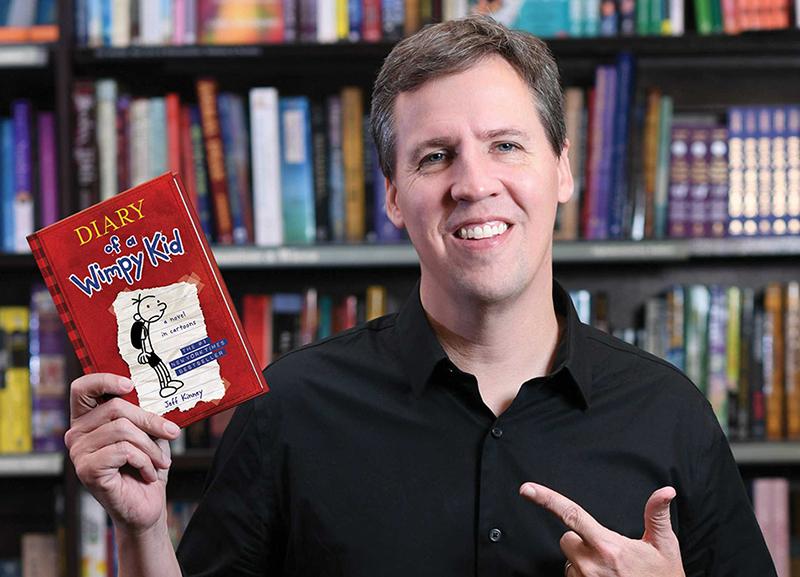
300+ million books. 75 languages. 93 international editions. 20 main-series titles already published. Eight feature films. Nearly two decades of continuous publishing success. Jeff Kinney’s Diary of a Wimpy Kid offers one of the clearest case studies of how a children’s book can evolve into a durable global intellectual property.
When Diary of a Wimpy Kid was published as a book in 2007, few could have predicted the scale of the business that would eventually grow around Greg Heffley.
Almost twenty years later, Jeff Kinney is no longer simply the author of a successful children’s series. He is the creator and long-term steward of one of the most internationally recognizable contemporary kids publishing properties.
And the numbers explain why.
300+ Million Copies
The headline number is extraordinary.
According to the official Wimpy Kid organization, the series has now sold more than 300 million copies worldwide.
To put the scale into perspective, 300 million copies across approximately 19 years since the first book appeared represents, as a simple mathematical average, almost 16 million copies for every year the property has existed in book form.
Actual sales obviously did not occur evenly—the franchise grew progressively—but the calculation illustrates the scale involved.
This isn’t simply a bestseller.
It is a global publishing platform.

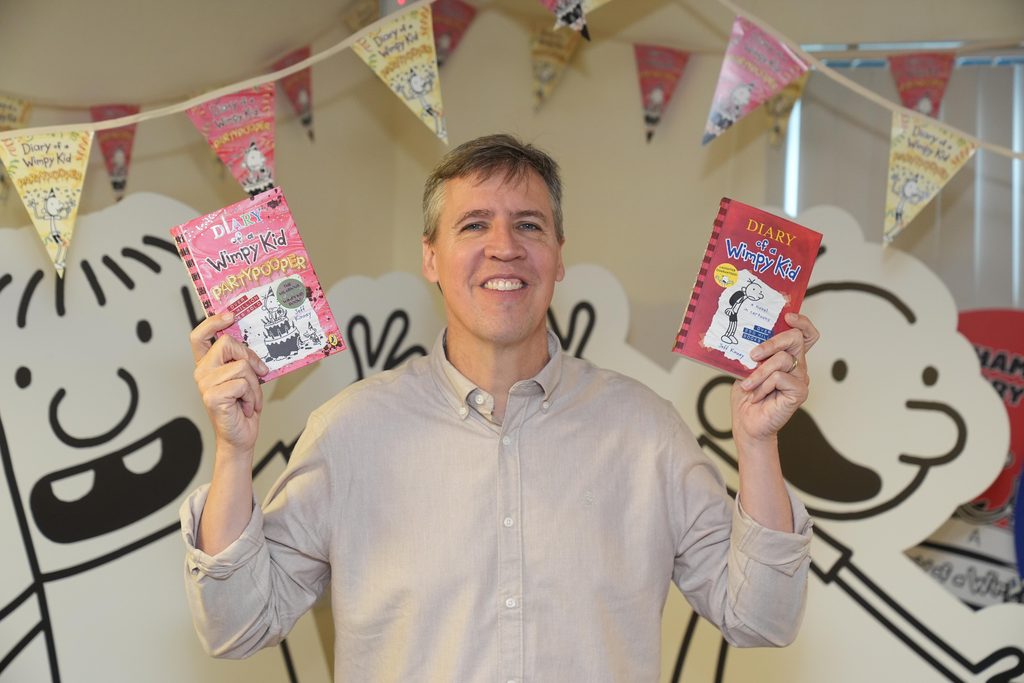
75 Languages. 93 Editions.
Perhaps an even more important figure for the international kids business is geographical reach.
The books are currently available in 75 languages and 93 editions, according to the property’s official site.
That matters because children’s humor can be notoriously difficult to export.
Comedy depends on language, cultural references, school environments and family dynamics. Yet Greg Heffley’s basic universe—school, parents, siblings, friendships, embarrassment and the desire to fit in—has proved remarkably portable.
That portability is one of the fundamental characteristics of powerful global IP.
From Six Years of Development to a Global Franchise
Kinney’s success was not instantaneous.
He began developing jokes and illustrations for the project in 1998.
He worked on the concept for approximately six years before publishing it in installments on Funbrain in May 2004. Those installments attracted millions of views.
In 2006, Kinney took a printed sample to New York Comic Con. A publishing deal with Abrams followed, and the first book appeared in April 2007.
The chronology is significant.
1998 — development begins
2004 — digital publication
2006 — publishing deal
2007 — first book
2025 — 300 million-copy milestone
What eventually became an international franchise therefore began with years of character and format development.
20 Main Books — and the 21st Is Coming
By 2025, the main series had reached 20 books, with Partypooper becoming the twentieth installment.
And the machine continues.
Book 21, Fight or Flight, is scheduled for publication on October 20, 2026.
This consistency is strategically important.
A successful kids IP needs repeated opportunities to reconnect with its audience while simultaneously recruiting new generations of readers.
Kinney has effectively created an annual publishing event around Greg Heffley.
More Than 800 Weeks on the New York Times Lists
Another remarkable number concerns longevity.
The official Jeff Kinney biography reports that the series has spent more than 800 weeks in total on New York Times bestseller lists, including more than 350 weeks on the series list.
That changes the interpretation of the phenomenon.
Wimpy Kid isn’t simply a property that experienced one explosive sales cycle.
It has demonstrated sustained consumer demand over many years.
And in children’s publishing, longevity can be more valuable than an isolated blockbuster.
Eight Movies
The transition from publishing into audiovisual entertainment demonstrates the second phase of the IP.
Disney reports that there are now eight Diary of a Wimpy Kid movies: four live-action films and four animated films.
The most recent animated production, Diary of a Wimpy Kid: The Last Straw, was released in 2025 on Disney+. Significantly, Kinney himself wrote and produced the movie.
That detail is important from an IP-business perspective.
The original creator has remained involved as the property expands into another medium.
Books → Movies → Digital → Merchandise → Stage
The franchise has also expanded beyond books and films.
Official Wimpy Kid material documents merchandise, games and a Diary of a Wimpy Kid musical, while Kinney also created the children’s virtual world Poptropica.
The business architecture therefore increasingly resembles the model KMN sees emerging throughout children’s entertainment:
Story → Character → Audience → Publishing → Screen → Licensing → Experiences → Long-term IP
Why Greg Heffley Travels
There is another lesson hidden behind all these numbers. Greg is visually simple. The world is understandable. The premise can be communicated almost immediately. The situations repeat without requiring the franchise to reinvent itself completely. And the character is recognizable even when separated from the original book. Those qualities matter enormously when an entertainment property begins travelling between formats and countries.
The $300 Million Question Isn’t the Right Question
A common mistake when examining a publishing phenomenon of this magnitude is trying to estimate how much money the author has personally earned. That isn’t the most interesting business question—and reliable public information does not allow us to calculate it accurately.
The more revealing question is: How much economic activity can one successful children’s IP generate across its lifetime?
Three hundred million books represent only one component. Add theatrical and streaming exploitation, international publishing rights, merchandising, games, stage productions, special editions and future adaptations, and the economic footprint becomes much larger than book sales alone.
The KMN Takeaway
Jeff Kinney demonstrates something fundamental about the modern kids economy.
The book can be the beginning rather than the end of the value chain.
The numbers are remarkable:
300+ million copies
75 languages
93 editions
20 main books published by 2025
21st arriving in 2026
800+ weeks across New York Times bestseller lists
8 movies
Nearly 20 years since the first book
But perhaps the most important number is harder to quantify: one character. Greg Heffley demonstrates what can happen when a simple, recognizable character becomes a relationship that successive generations of children want to revisit. That is the difference between producing a bestselling children’s book and building a global kids IP.
Informazioni sull'autore