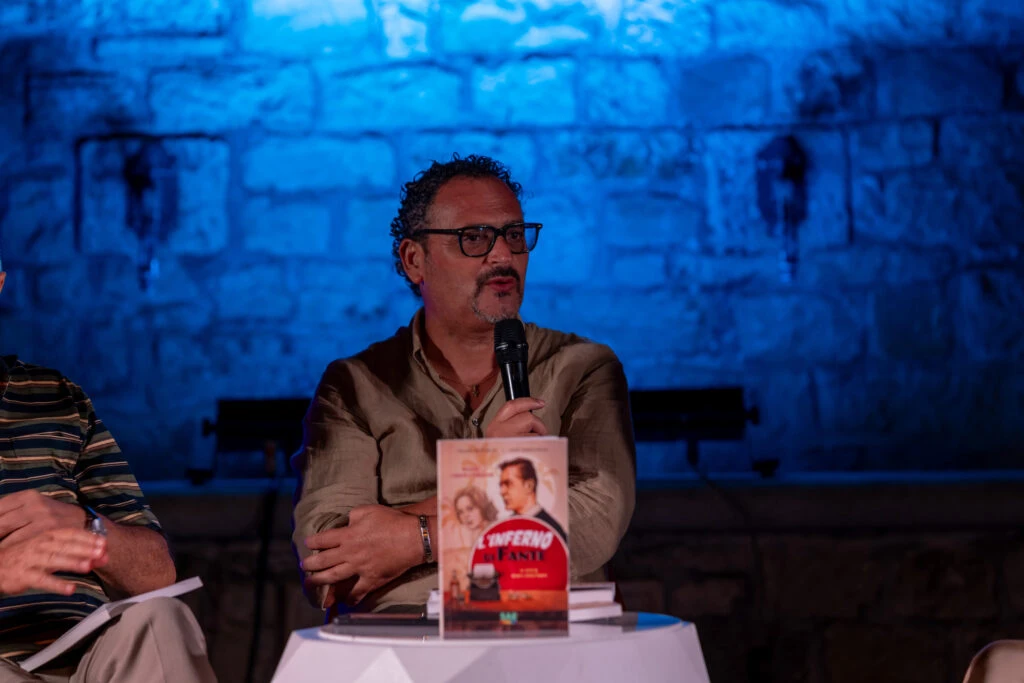
Almond Entertainment Creative Director Dario Gulli explains why the kids media industry is moving from content production toward IP creation.
Slug: dario-gulli-future-kids-media-ip-economy
Tags: Dario Gulli, Almond Entertainment, Intellectual Property, Kids Media, Children’s Publishing, Animation, Licensing, Gaming, Creative Industries, Fondazione Pescarabruzzo, Nicola Mattoscio
The Creative Director of Almond Entertainment discusses the transformation of children’s publishing into an international IP business, the relationship between books, animation, licensing, technology and global markets — and why territories need vision as much as capital to build a creative industry.
KMN: You often say that today a book should not necessarily be thought of only as a book. What do you mean?
DARIO GULLI: First of all, a book must work as a book. I do not believe in creating a weak book simply because somebody thinks the character could become a cartoon or a toy. The reader comes first. But when we develop a property for children, I ask a second question very early: is there a world behind this story? Can the character live another adventure? Can children recognize it immediately? Can the idea survive in another language? Could it become animation, a game, a comic or an educational experience without losing its identity? That is where a book starts becoming an IP.
KMN: So what is the difference between an author and an IP creator?
DARIO GULLI: An author creates a story. An IP creator also begins to understand the architecture around that story: characters, world, visual identity, audience, rights and potential extensions. The emotional idea must always come first. What changes is the awareness that a strong character may have a life of ten, twenty or fifty years.
KMN: Almond has developed publishing properties that have travelled extensively around the world. What has that taught you about IP?
DARIO GULLI: International publishing is an extraordinary laboratory. When the same property begins to connect with readers in very different countries, you start to understand which elements are genuinely universal. At Almond, international rights are not simply a source of revenue. They are also information. They tell you where a character works, where a concept travels and where an IP may have the potential to become something larger than its original format.
KMN: What is the mistake publishers make when they talk about IP?
DARIO GULLI: Thinking that IP means merchandise. It does not. A mug with a character printed on it is not an IP strategy. An IP is the relationship between an audience and a fictional world. Licensing monetizes that relationship. Animation can amplify it. Games can deepen it. Publishing can begin it. But without the relationship, none of those businesses are sustainable.
KMN: Is character more important than format?
DARIO GULLI: Absolutely. Formats change constantly. Television changed, streaming arrived, YouTube arrived, webtoons arrived, gaming became central, and AI will create another transformation. Strong characters survive technologies. That is what makes IP so valuable.
KMN: Does every publisher need to become an entertainment company?
DARIO GULLI: No. Publishers should publish and editors should discover great books. What publishers need is a better ability to identify which small percentage of their catalogue contains expandable IP. Most books should remain books. But one exceptional property can change the economics of an entire catalogue.
KMN: What do you look for in scalable IP?
DARIO GULLI: A recognizable character, a strong emotional idea, repeatability, a world, visual identity and something I call playability. Can a child do something with this world? Can they imagine themselves inside it, collect something, choose something or become one of the characters? That becomes extremely important when you move toward gaming, digital or consumer products.
KMN: How important is technology?
DARIO GULLI: Fundamental, but technology should remain a tool. I am not interested in technology because it looks modern. I am interested when it makes the relationship with the story deeper. If AR adds nothing, do not use AR. If an app adds nothing, do not build the app.
KMN: And artificial intelligence?
DARIO GULLI: AI will change development, localization, production workflows, marketing, data and discovery. But we have to distinguish between making content cheaper and making IP more valuable. When content becomes infinite, originality becomes more valuable. The scarce resource will be identity.
KMN: Is Europe competitive enough?
DARIO GULLI: Europe has extraordinary creativity, but we often keep writers, publishers, animation studios, universities, museums and technology companies in separate rooms. The opportunity is to connect them more intelligently and think internationally from the beginning.
KMN: And what role can smaller territories play?
DARIO GULLI: A very important one. Creative industries do not require every great idea to be born in Los Angeles, London, Tokyo or Seoul. A territory can create incubators, universities, production infrastructure, museums, festivals, startup ecosystems and international networks. But infrastructure alone is not enough. It requires vision.
KMN: You have worked extensively in Abruzzo. Do you see that possibility there?
DARIO GULLI: Very much. I want to thank Nicola Mattoscio, President of Fondazione Pescarabruzzo, because he has something that is rare: the ability to see culture not simply as preservation, but as an instrument for the future. His vision connects culture, technology, education, entrepreneurship and international relationships. That is exactly what creative industries need.
KMN: Why has that vision been important?
DARIO GULLI: Real innovation requires somebody willing to see the connection before it becomes obvious. Nicola Mattoscio has demonstrated a unique vision of what a foundation can do for a territory. Investing in ideas can create companies, jobs, talent, identity and international opportunity. For anyone trying to connect publishing with animation, technology and IP development, finding an institutional partner capable of understanding that language is extraordinarily valuable.
KMN: Where is kids media heading?
DARIO GULLI: Towards convergence. Publishing, animation, gaming, licensing, streaming and technology will remain different professional industries, but audiences will experience them as one thing. A child discovers a character on YouTube, reads the book, plays the game, watches the animation and visits the experience. For the child there are no divisions. There is only: ‘I love this world.’ Great IP is ultimately a story people do not want to leave.
KMN Takeaway
The argument is straightforward: the children’s entertainment business is moving from a content economy toward an IP economy, where the strategic asset is the relationship between characters, audiences and multiple forms of media. Creative IP also depends on territories and institutions capable of connecting culture, technology, entrepreneurship and international ambition.
Sources
Almond Entertainment
Fondazione Pescarabruzzo
ARTICLE | STREAMING / LEADERSH
Informazioni sull'autore