

Slug: 10-childrens-authors-building-global-ip
Tags: Children’s Authors, IP Creators, Dav Pilkey, Jeff Kinney, Aaron Blabey, Liz Pichon, Philip Osbourne, Children’s Publishing, Book-to-Screen
KMN selects ten children’s creators whose books demonstrate how characters can evolve into screen, games, licensing and long-term global IP.
From publishing phenomena to animation, streaming, theatre, licensing and digital worlds, these ten creators show how a children’s book can become the starting point for something much bigger.
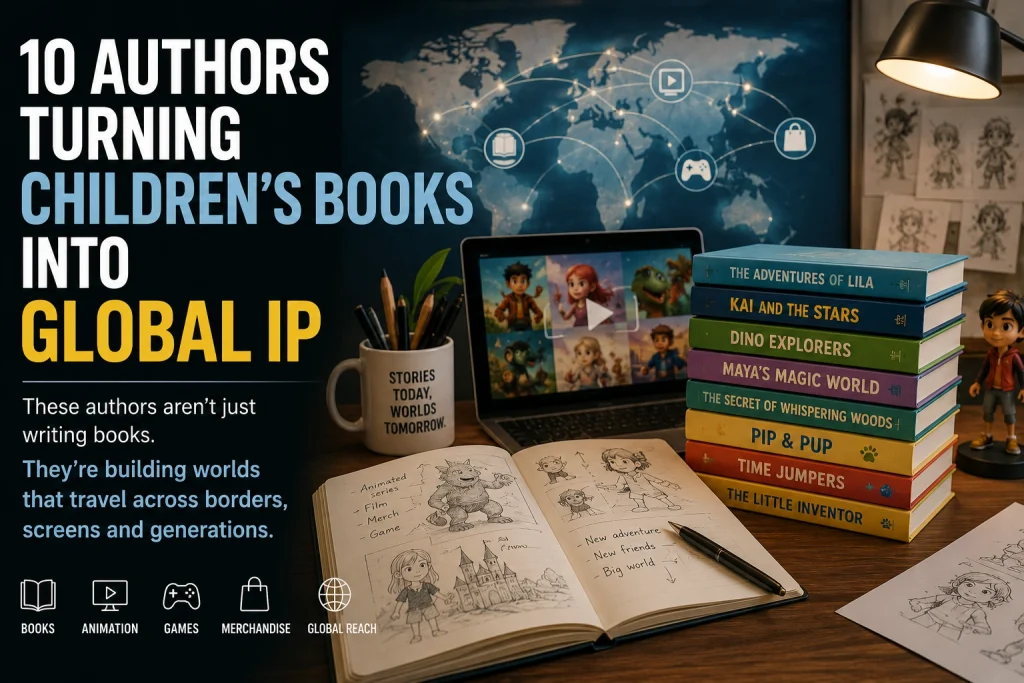
For much of publishing history, the principal measure of success was relatively straightforward: how many books were sold? That metric still matters. A great children’s property begins with readers. But the global children’s entertainment industry is changing the question. Today, publishers, producers, agents and investors increasingly want to understand not only whether a book can sell, but whether its characters, visual language and narrative universe can travel — across territories, formats, platforms and generations. A book can become animation. A character can become a consumer-products property. A graphic novel can become a theatrical film. A publishing universe can generate spin-offs, games, stage productions and digital experiences.
The most interesting creators in contemporary children’s publishing therefore operate, intentionally or otherwise, at the intersection of authorship and intellectual property. For this KMN editorial selection, we looked at ten authors whose work illustrates different ways in which publishing can become the foundation of a broader IP ecosystem. This is not a ranking of the world’s “best” children’s authors, nor a ranking based purely on sales. It is an editorial selection examining creators whose properties offer particularly interesting lessons about how children’s publishing can travel beyond the book.
- DAV PILKEY
The IP: Dog Man / Captain Underpants
Few contemporary creators demonstrate the power of author-driven children’s IP as clearly as Dav Pilkey.
Scholastic reports more than 70 million Dog Man books in print worldwide, with the series available in 50 languages. Captain Underpants adds another 90 million books in print. But the numbers only partly explain Pilkey’s relevance. Dog Man has developed into an interconnected publishing universe, including the Cat Kid Comic Club spin-off, while the property has also expanded into theatre and film. DreamWorks Animation’s Dog Man movie opened at number one at the box office, according to Scholastic. Captain Underpants had already demonstrated the same capacity for migration, moving from books into a DreamWorks feature film and a Netflix series.
Why KMN selected him
Pilkey demonstrates something fundamental about children’s IP: a distinctive creative language can itself become a brand. The drawings, humour, typography and anarchic storytelling are not simply packaging around the stories. They are part of the property’s identity. That makes the work immediately recognisable — one of the most valuable characteristics an IP can possess.
KMN IP lesson: Own a visual and narrative language audiences can recognise before they even read the title.
- JEFF KINNEY
The IP: Diary of a Wimpy Kid
Jeff Kinney represents one of the clearest examples of an illustrated publishing concept becoming a global entertainment franchise.
The official Wimpy Kid site reports more than 300 million books sold globally, with the series appearing in 93 editions and 75 languages. Perhaps even more interesting is where the property began. Kinney spent years developing the concept before releasing it online through Funbrain in 2004. Millions of views preceded the eventual print publishing deal, and the first book appeared in 2007. The franchise subsequently expanded into multiple feature films and animated adaptations. The lesson is significant because Wimpy Kid is not built around fantasy spectacle or superheroes. Its strength is a highly repeatable combination of character, humour, illustration and recognisable everyday experience.
Why KMN selected him
Kinney proves that enormous IP does not necessarily require an enormous fictional universe. Sometimes the character is the universe. Greg Heffley’s worldview is sufficiently distinctive to sustain books, films, international editions and an enduring global audience.
KMN IP lesson: Repeatability can be more important than scale of concept.
- AARON BLABEY
The IP: The Bad Guys
The Bad Guys provides an extraordinary contemporary case study in what can happen when publishing and animation reinforce each other.
The series began as Aaron Blabey’s illustrated books about a group of supposedly villainous animals trying to become heroes. Then came DreamWorks. The first Bad Guys feature film was released in 2022, followed by The Bad Guys 2. DreamWorks says the publishing series has grown from approximately 8 million copies before the first film to more than 30 million copies sold. That is particularly revealing. The relationship between books and screen is not necessarily:
BOOK → MOVIE → BOOK BECOMES SECONDARY
Instead, it can become:
BOOK → AUDIENCE → MOVIE → LARGER AUDIENCE → MORE BOOKS → STRONGER IP
Why KMN selected him
Blabey’s property demonstrates the multiplier effect that a successful screen adaptation can have on its publishing source. The characters also possess the ingredients animation companies and licensing businesses value: silhouettes, personalities, ensemble dynamics, humour and immediate visual recognition.
KMN IP lesson: Adaptation does not have to replace publishing. Done well, it can dramatically enlarge it.
- LIZ PICHON
The IP: Tom Gates
Liz Pichon’s Tom Gates is another example of illustrated storytelling developing into a much wider creative property.
According to Pichon’s official site, the series has sold more than 16.5 million copies worldwide and has been translated into 46 languages. Its expansion is particularly interesting because Pichon has remained creatively involved beyond the original books. The Brilliant World of Tom Gates became a television series, with Pichon co-writing scripts and songs. She also co-wrote a Tom Gates stage production that toured the UK.This is not simply rights exploitation. It is an example of the creator’s voice travelling with the property.
Why KMN selected her
Tom Gates illustrates the value of creative consistency across formats. Its doodles, typography, humour, music and school-life universe create an identity that can survive movement between publishing, television and performance.
KMN IP lesson: When the creator’s voice is central to the brand, preserving that voice across formats can become a competitive advantage.
- PHILIP OSBOURNE
The IP: Diary of a Nerd and a portfolio of international children’s properties
Philip Os bourne offers a different case study: the development of children’s publishing properties specifically with international mobility and cross-media potential in mind.
According to Almond Entertainment, Osbourne’s books have been published in more than 50 countries, while Diary of a Nerd alone is listed as published in 52 countries.The Diary of a Nerd universe has expanded beyond its original series into additional books and spin-off properties, including The Super Adventures of Elen and Teo, A Genius Dog. Almond presents the property as one designed for further development across cartoons, games, merchandise and educational applications. Osbourne’s wider catalogue also demonstrates a portfolio approach to IP, with properties conceived across illustrated fiction, comics and concepts capable of audiovisual development.
Why KMN selected him
The interesting element here is international rights as an IP laboratory. When a children’s property works in culturally different publishing territories, those markets provide information. They show which characters, themes and concepts possess international portability. Publishing rights therefore become more than revenue. They become evidence. For smaller and independent IP creators in particular, international publishing can be the first stage in demonstrating that a property has the ability to travel.
KMN IP lesson: Every territory in which a property succeeds provides another piece of evidence about its global potential.
- LINCOLN PEIRCE
The IP: Big Nate
Lincoln Peirce’s Big Nate demonstrates the power of a character that can exist naturally across adjacent forms of visual storytelling.
Nate Wright originated in Peirce’s comic strip before expanding into bestselling children’s books. The property subsequently made the transition to animation through Nickelodeon Animation Studio. Paramount+ launched the Big Nate animated series in 2022, based on Peirce’s books and comic strip and initially announcing 26 episodes. The transition feels natural because the fundamental DNA of the property was already visual. Character comedy, school situations and a strong graphic identity provide an unusually direct bridge between page and screen.
Why KMN selected him
Big Nate demonstrates the importance of format compatibility. Some publishing properties require substantial reinvention before they can become audiovisual entertainment. Others already contain the visual grammar of animation.
KMN IP lesson: The shorter the creative distance between formats, the easier an IP may be to expand.
- MARC BROWN
The IP: Arthur
If many contemporary creators demonstrate how books can become IP, Marc Brown demonstrates something even more valuable: longevity.
Arthur began with Arthur’s Nose in 1976. The books eventually became the foundation of one of the most durable children’s television properties in modern media. PBS says the animated series grew from Brown’s books into television, movies, audiobooks, music, apps and digital experiences. PBS Distribution reports that Arthur books have sold more than 70 million copies, while the television programme has aired in more than 90 countries and ran for 25 seasons. That changes the way we should think about IP value. A successful children’s property is not necessarily one that produces the biggest launch. It may be one that remains culturally relevant for decades.
Why KMN selected him
Arthur shows that children’s IP can become generational infrastructure. Parents who encountered the character as children can later introduce it to their own children. That intergenerational recognition is exceptionally difficult to manufacture — and exceptionally valuable once achieved.
KMN IP lesson: The ultimate measure of IP may not be reach. It may be time.
- RACHEL BRIGHT
The IP: The Lion Inside and a global picture-book portfolio
Rachel Bright demonstrates that scalable IP does not belong exclusively to middle-grade series or graphic novels.
Picture books can create globally recognisable characters too. Hachette reports that Bright’s books have collectively sold more than five million copies worldwide and have been translated into 47 languages. More strikingly, the tenth-anniversary edition of The Lion Inside, created with illustrator Jim Field, states that this single title has now sold more than five million copies worldwide in 42 languages. The strength of the property lies in simplicity: an immediately understandable emotional idea combined with highly recognisable animal characters.
Why KMN selected her
Bright demonstrates the international power of emotional universality. Confidence, fear, friendship and self-belief require relatively little cultural translation. Combined with strong visual characters, that makes picture-book storytelling unusually portable. KMN IP lesson: A simple universal emotion can be as scalable as an elaborate fictional universe.
- TOM FLETCHER
The IP: The Christmasaurus and a broader children’s publishing universe
Tom Fletcher occupies an interesting position between publishing, music and entertainment.
Penguin reports that his books have been translated into 42 languages, with 10 million copies sold globally. The Christmasaurus became the biggest debut children’s novel of 2016 in the UK and subsequently developed into a series.
The property is particularly interesting because Fletcher’s background allows music and performance to sit naturally alongside storytelling. Penguin has previously reported development of The Christmasaurus as an animated feature project with The Greatest Showman director Michael Gracey, with original songs by Fletcher.
Why KMN selected him
Fletcher illustrates the potential of multidisciplinary creators. The future of children’s IP may increasingly favour creators capable of thinking not only in prose but in music, performance, audiovisual storytelling and audience experience.
KMN IP lesson: The more creative languages an IP can speak authentically, the more doors it can potentially open.
- KES GRAY
The IP: Oi Frog and Friends
Kes Gray and illustrator Jim Field demonstrate how a seemingly simple picture-book idea can become a repeatable publishing system.
Oi Frog! takes a wonderfully straightforward concept — animals must sit on objects that rhyme with their names — and turns that linguistic rule into comedy. Hachette reports that Oi Frog! itself has sold more than one million copies, while the wider Oi Frog and Friends series has surpassed three million copies and has also been adapted for theatre. The property has continued expanding through titles including Oi Dog!, Oi Cat!, Oi Puppies!, Oi Aardvark! and Oi Dinosaurs!. There has even been an interactive app built around the rhyming world and its characters.
Why KMN selected him
Gray’s work demonstrates something easy to underestimate: a format can itself become intellectual property. The repeatable rule of the Oi universe generates new books, characters and interactions without abandoning the central promise.
KMN IP lesson: A strong creative mechanic can be as important as a strong character.
What these ten creators have in common
Their work is extremely different. Pilkey’s graphic novels do not resemble Rachel Bright’s picture books. Arthur is structurally different from The Bad Guys. Diary of a Wimpy Kid follows a different commercial path from Tom Gates or Oi Frog. And that is precisely the point. There is no single formula for building children’s IP. But several recurring characteristics emerge.
- Recognition
Strong IP can often be identified immediately.
A drawing style. A silhouette. A character. A title treatment. A voice.
Recognition reduces the distance between encountering a property and remembering it.
- Repeatability
A great story can end.
A great IP often contains a reason for another story to begin.
That may come from a character, a world, a comic mechanism, a school environment, an ensemble or a narrative format.
- International portability
Translation rights remain one of publishing’s most useful tests of universality.
A property that works in dozens of territories has demonstrated something that cannot be established by a pitch deck alone: people from different cultures want it.
- Format mobility
Not every successful book should become animation.
Not every animation needs merchandise. But the properties in this selection demonstrate an ability to retain their identity when they move. That is the critical distinction. Adaptation should not merely reproduce the source. It should extend the relationship between the audience and the IP.
- Creator identity
Another important pattern is the role of the creator.
Pilkey’s drawing is inseparable from Pilkey’s storytelling. Pichon’s visual language defines Tom Gates. Brown’s relationship with Arthur has lasted decades. Successful IP development does not necessarily mean removing the author once the publishing rights are sold. Increasingly, creators can become part of the strategic architecture of the franchise.
The book is becoming the beginning
The publishing industry should be careful with the phrase “IP”. A book should not be treated merely as raw material for television.
Literary quality, originality, emotion and the relationship with the reader remain fundamental. Indeed, the most durable franchises generally become valuable because audiences loved the original experience first. But the business environment surrounding children’s publishing is unquestionably changing. Publishers are interacting more frequently with animation studios. Streaming companies search publishing catalogues. Licensing companies look for emerging characters. Game developers look for worlds. Producers look for communities. And international rights markets increasingly operate alongside audiovisual and licensing markets. The book remains extraordinarily powerful because it can accomplish something few other media can do at comparable cost: it can prove that a world deserves an audience. Once that happens, the possibilities become much larger.
KMN IP MATRIX
Creator Publishing Engine Expansion Dav Pilkey Dog Man / Captain Underpants Film, streaming, theatre, spin-offs Jeff Kinney Diary of a Wimpy Kid Film, animation, global franchise Aaron Blabey The Bad Guys DreamWorks theatrical animation Liz Pichon Tom Gates Television, theatre, music Philip Osbourne Diary of a Nerd / IP portfolio International rights, spin-offs, cross-media development Lincoln Peirce Big Nate Comics, books, animation Marc Brown Arthur TV, film, audio, apps, education Rachel Bright The Lion Inside Global picture-book IP Tom Fletcher The Christmasaurus Publishing, music, audiovisual development Kes Gray Oi Frog and Friends Publishing, theatre, interactive
KMN Takeaway
The lesson from these ten creators is not that every children’s book needs to become a franchise. It is almost the opposite. The book has to work first. Children do not fall in love with licensing strategies. They fall in love with characters, humour, worlds and stories. But when that relationship exists, the economics surrounding the book can change dramatically. Publishing can become animation. Animation can generate discovery. Discovery can increase book sales. Characters can enter licensing. Digital platforms can create communities. Communities can sustain new stories. And new stories can introduce the property to another generation. The modern children’s author may therefore remain exactly what authors have always been — a storyteller. But increasingly, the world created by that storyteller can become something more: a global intellectual property.
Informazioni sull'autore