From Gabby’s Dollhouse and Ms. Rachel to the extraordinary KPop Demon Hunters phenomenon, Netflix’s latest engagement data reveals a kids and family business built increasingly around repeat viewing, global franchises and IP that can travel far beyond the screen.
Netflix’s enormous viewing dataset is becoming one of the most useful windows into the global entertainment market.
The company’s latest Engagement Report says audiences watched more than 97 billion hours of Netflix content between January and June 2026, the highest total yet reported by Netflix for a six-month period. The previous two halves had already generated more than 95 billion hours in H1 2025 and 96 billion hours in H2 2025.
For the children’s entertainment industry, however, the more interesting story lies beneath the overall number.
Kids and family viewing illustrates how streaming is changing the economics of children’s intellectual property: success is increasingly about longevity, repeatability, international reach and the ability to turn a screen property into a much larger entertainment ecosystem.
Gabby’s Dollhouse: 216 Million Views Across 2025
One of the clearest examples is Gabby’s Dollhouse. Netflix reported approximately 108 million views across the franchise’s seasons during the first half of 2025. Remarkably, it reported another 108 million views across seasons in the second half.
That produces a simple but striking figure:
≈216 million reported views across Gabby’s Dollhouse seasons during 2025.
The significance is not simply the size of the audience. Gabby demonstrates one of the fundamental characteristics of successful preschool streaming: a franchise does not necessarily need a gigantic launch followed by rapid decline. A library of episodes can generate sustained consumption for months and years. For rights owners, that makes catalogue depth an increasingly important asset.
Ms. Rachel Shows How the Creator Economy Is Entering Kids Streaming
Another revealing case is Ms. Rachel. In the first half of 2025, Netflix reported 53 million views for Season 1. During the second half, Netflix reported 73 million views across both seasons. The importance of Ms. Rachel goes beyond the numbers. It represents the movement of children’s entertainment talent from the creator economy into premium global streaming distribution. The traditional path used to run approximately:
book or television concept → broadcaster → licensing → consumer products.
The new ecosystem can also run:
digital creator → online audience → streaming platform → global IP.
That dramatically expands where the next major preschool franchise might originate.
KPop Demon Hunters Changed the Scale of the Conversation
Then there is KPop Demon Hunters. The film registered 37 million views during the first half of 2025, despite debuting only on June 20. In the following six months, Netflix reported an extraordinary 482 million views, making it the platform’s most-watched title over that reporting period. But the phenomenon continued. By June 2026, Netflix said the film had accumulated more than 600 million views since launch, making it the most popular Netflix original title in the company’s history. The geographic penetration is equally important. Netflix says the movie reached the Top 10 in all 93 countries for which it publishes Top 10 rankings and reached No. 1 in 76 countries. It also became the only title to remain in Netflix’s Global Top 10 for 52 consecutive weeks. Those are not merely streaming statistics. They are indicators of global IP penetration.
From 600 Million Views to 15 Billion Music Streams
The most interesting aspect of KPop Demon Hunters may actually be what happened outside Netflix. According to Netflix, the movie’s soundtrack generated more than 15 billion streams worldwide, spent two weeks at No. 1 on the Billboard 200 and appeared in more than 17,000 playlists. Netflix is also expanding the property into physical and interactive products, including toys from major partners, LEGO products, Netflix House experiences and mobile games. This is precisely where the economics of kids media becomes interesting. A successful animated property can now move through an ecosystem such as:
Streaming → Music → Social → Games → Toys → Experiences → Licensing
Streaming therefore becomes not simply a distribution channel but potentially the first stage of a much larger IP business.
Preschool Remains an Extraordinary Repeat-Viewing Business
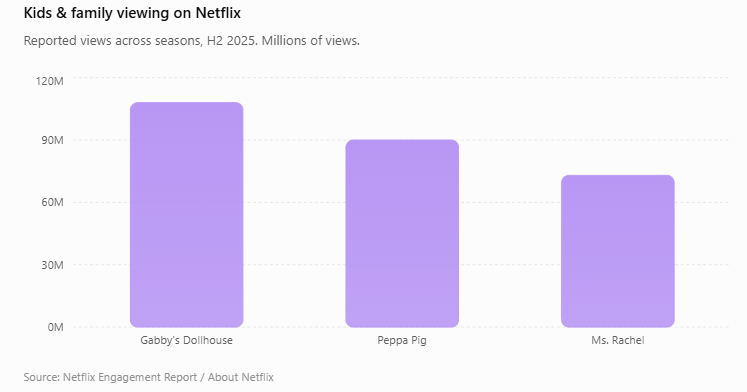
The second half of 2025 provides another revealing set of numbers.
| Kids / Family Property | Netflix reported views, H2 2025 |
|---|---|
| Gabby’s Dollhouse | 108M across seasons |
| Peppa Pig | 90M across seasons |
| Ms. Rachel | 73M across both seasons |
| In Your Dreams | 47M |
| Mark Rober’s CrunchLabs S1 | 12M |
| Sesame Street: Volume 1 | 6M |
The presence of both new and decades-old properties is particularly significant. Peppa Pig and Sesame Street coexist with Ms. Rachel and newer Netflix-driven properties. Streaming has therefore not eliminated the value of legacy children’s IP. In some respects, it may strengthen it by making enormous libraries permanently accessible to new generations.
The Library Is Becoming as Important as the Premiere
Another number deserves attention. Netflix reported that in the first half of 2025, nearly half of all viewing of Netflix Originals came from titles originally launched in 2023 or earlier. That is strategically important for children’s media. Kids content has traditionally possessed unusually long commercial lives because every year introduces a new generation of viewers into the target demographic. Streaming can amplify that phenomenon. A children’s series does not necessarily become “old” after its first release window. If discovery continues, an existing catalogue can effectively acquire new audiences indefinitely. Netflix itself argues that engagement matters because higher viewing can contribute to retention, recommendations and perceived value of the service.
Global Kids Content Is Becoming Less Dependent on Geography
There is another structural shift. In H2 2025, more than one-third of all Netflix viewing came from non-English-language titles. This does not represent kids content alone, but it provides important context for anyone developing children’s IP. Language and country of origin are becoming weaker barriers to international discovery. Korean entertainment is perhaps the most visible example, but the kids sector offers similar signals. Netflix specifically highlighted French production Asterix & Obelix: The Big Fight, which generated 16 million views in H1 2025. For independent producers and publishers, that changes the strategic question. The question is no longer simply: “Can this work in my domestic market?” Increasingly it is: “Can this concept be understood, loved and extended internationally?”
The Numbers Netflix Does Not Give Us
There is an important limitation. Netflix’s public data does not provide a complete standalone figure for the percentage of total viewing generated specifically by children. We therefore should not claim that “X% of Netflix is kids content” without additional reliable evidence. Netflix defines a view in these Engagement Reports as total hours viewed divided by runtime, which makes comparisons between titles more useful than raw hours alone, but the company also stresses that viewing volume is not the sole definition of success. That distinction matters. A relatively smaller preschool programme could still be extremely valuable if it has lower production costs, exceptional repeat viewing, strong retention effects or substantial licensing potential.
What the Data Tells the Kids Industry
Taken together, the numbers point toward a significant change in the children’s entertainment business. The most valuable kids properties are increasingly not simply television programmes. They are IP systems. A successful property may begin with animation, a book, a YouTube creator or even music. What matters increasingly is whether the idea can move between platforms while maintaining audience recognition. Gabby’s Dollhouse demonstrates the power of sustained franchise consumption. Ms. Rachel demonstrates the convergence of creators and streaming. Peppa Pig demonstrates the continuing economic value of established IP. And KPop Demon Hunters demonstrates something potentially much larger: how quickly a globally distributed screen property can become a cultural and commercial ecosystem.
The Next Battle Is Not Simply for Viewing Hours
For Netflix and its competitors, the next stage of the kids streaming market may therefore be less about accumulating enormous catalogues and more about identifying properties capable of escaping the platform itself. The winners will be the franchises that can move naturally between streaming, publishing, licensing, consumer products, music, games and physical experiences. The numbers already suggest that this transition is underway. Netflix may be measuring views. The children’s media industry should be measuring how many of those views can become long-term intellectual property.
KMN DATA BOX
97B+ — Netflix hours watched globally, H1 2026.
600M+ — KPop Demon Hunters views since launch by June 2026.
93 countries — markets where KPop Demon Hunters entered Netflix’s Top 10.
216M — approximate combined 2025 views reported across Gabby’s Dollhouse seasons (108M H1 + 108M H2).
90M — Peppa Pig views across seasons in H2 2025.
73M — Ms. Rachel views across both seasons in H2 2025.
15B+ — global streams of the KPop Demon Hunters soundtrack reported by Netflix by June 2026.


Informazioni sull'autore